-

-

Sunday, December 3, 2017

Project 1.3

Project 1.3 
Fraternal Twins

This is the third phase of the project starting from the beginning of the semester. I have experienced the case study and designing a board game developed the strategy from the case study(School in Vila Nova da Barquinha). In this phase, it was my turn to design a school using the DNA from previous phase.


It is so easy to spot the dominance of this case study building. So I decided to keep the variable in this case is the use of courtyard. The case study have shown that its courtyard have been use as the connection between space in the school. But I changed the use of it to the separation between space and direction of the circulation in side the facility. Actually, this is not a school but an additional facility to support the school to give life more comfortable. As the strategy of the game, just like chess plus you have to be aware of your own area. So this design had aware about the area of the school.

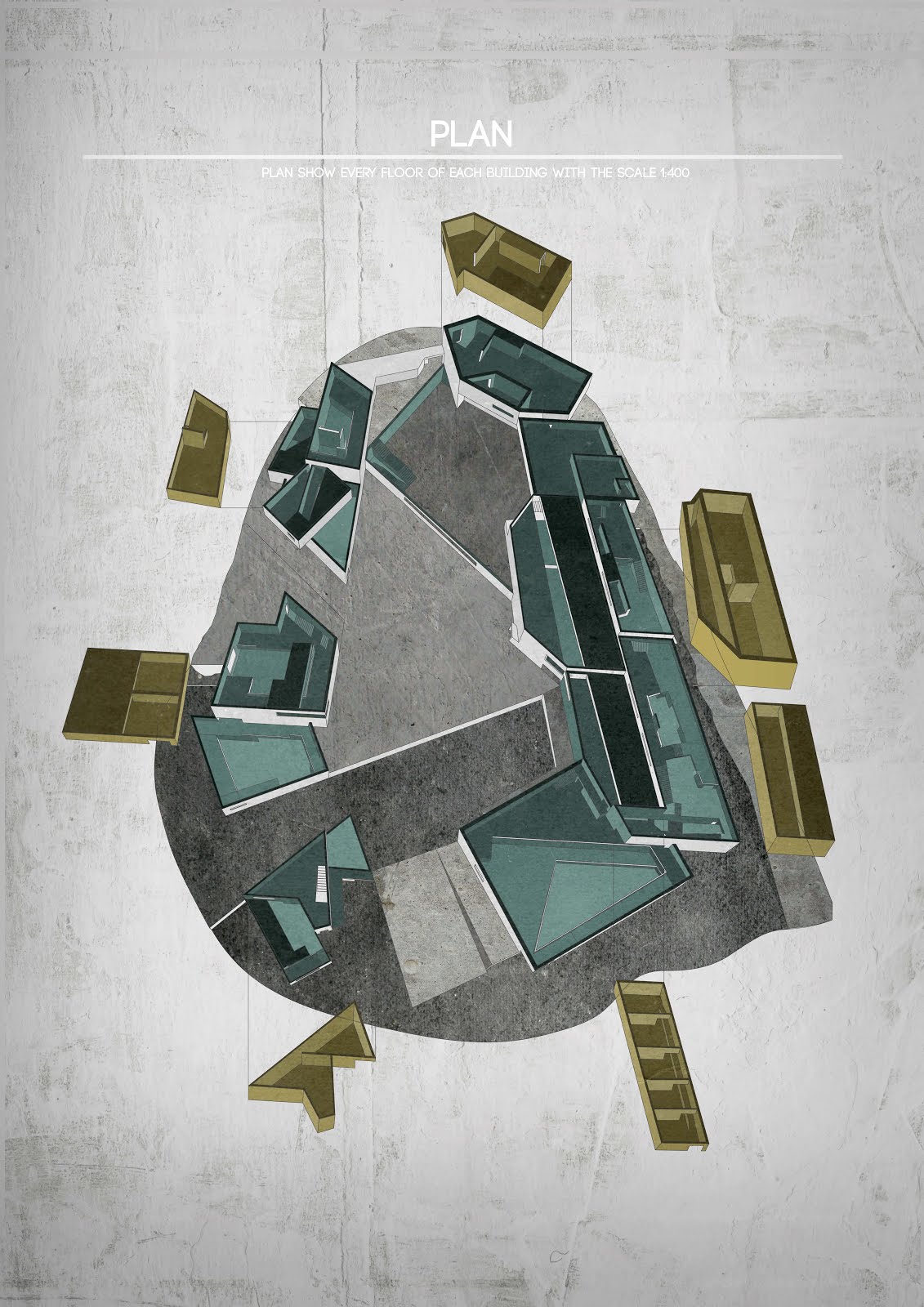
This facility includes a library, art gallery, sport complex, music hall, napping room, dancing studio and a car park. there are two courtyards the first one separated the art & performing building from the library and another one with is jointed but cannot access to each building, you have to go through the over-sized wall which lies around the area.

Lastly, there is a disagreement of my own to what Aires Mateus' words. They once said that they designed the school to look like castle so the children would feel safe and secure inside but I think you would not want your children to 'judge to book by its cover,' so I put in a very simple and boxed-look facade. So it looks a little boring but with an over-sized door as a point of interest. 

PROJECT 3 PHATCHANON VARANUKULSAK: FRATERNAL TWINS

PROJECT 3 

FRATERNAL TWINS

PHATCHANON VARANUKULSAK
Aj. Nuno Sousa


         Image result for ALVARO SIZA

 Image result for FAUP


From the Faculty of architecture of porto built by Alvaro Siza, The language of FAUP was extracted from the first phase which has pre-existing element, topography, visibility and continuity and developing into the second phase that is strategy-toy, Combined into the building in last phrase


Starting with experiment in the massing, the unit plan in the toy from the second phase was rearrange form and shape to find the new possibility of form and DNA in architecture and then i keep on with the one long-building and four small-building for creating the sequence, vision and continuity of terrain and building which come from the site the surrounding. For example, the long-building is higher than the other because of terrain allowed vision to the student to see through the space between the building on left side and the shape of all building also be like a opened-triangle shape to the outside which allow vision from the inside to the outside
 1.Find inspiration and researching
The program of building was created from types of building which have library, game and movie room for the first building, different types of  working room for the second building, discussion and communication for the third and exhibition for the last.


  the relation of each building was developed and improved from the visibilitywhich cut out some unnecessary parts of buildings allowing the vision from another side.
continued with visibility, shapes of the building was bend from perspective rules which expand from the inside to the outside both in the interior and exterior caused the continuity on exterior which is circulation, shapes and terrain and in the interior which are related with relation of ceiling, floor, wall and space combined as a one line from perspective views


the purpose of the new building came form the idea of working process of architecture student which was separated into 4 steps.

2. experiment and working
3. debating and discussion
4. exhibition


the surrounding influenced the topography and visibility to the douro river that create the inspiration for the student in the faculty


palida nai - phase 3

NAI PALIDA EMWATTANA  PROJECT 1.3 : Fraternal twins

PROJECT 1.3 - Fraternal twinsLuis De Freitas Branco School ,Celia Gomes+Pedro Machado Costa

The primary focus of my case study was Portuguese architect Celia Gomes and her redesign of Luis de freitas Branco school in 2016 to connect exterior and interior spaces of the school and to provide better circulation. I selected this case study because Gomes choose to redevelop this building rather than demolish it and start fresh.  


In phase 3, I decided to build a dormitory on a site that is relatively close to the Luis de freitas. I made this decision for several reasons: first, I want to create a self-sustained environment for students,giving them the opportunity to stay close to their school so that they do not have to commute; second since the topography of this area is quite steep, I was forced to think about how people would circulation through my dormitory and how exterior and interior  spaces could be connected


The dormitory that I have designed features a translation of the three forms.The first benefit of these features is that, together,they create an open environment than encourages studying and community.


Plan , section ,and elevation


The spiral ramp allows me to connect my three floors together without using enclosed staircase, while the skylight serves as a sort of clear ceiling that makes those inside the building feel connected to the outside world.


On top of this, the skylight also allow for light to filter into the building. This natural light can eliminate the need for a tremendous amount of artificial light, which is more beneficial for studying and living.


As for the site itself, I have decided to build a layered building in conjunction with the steep topography.Most building are built in flat spaces that allow for easy circulation, but I believe that this wont always be possible and that architects should not alter the site just to make it flat. I have to solve the problem of circulation by designing ramps and stars, as well as elevated bike path,  which students wind back and forth across the site.


Tanyaluck Kittithirapong Phase 3


Phase 3 : Fraternal twins
Tanyaluck Kittihtirapong
Nuno Sausa  

case study DNA :
Lycée Hotelier de Lille by Caruso St John


from previous phases'  building analysis, I have gathered many infomation of the building characteristics and DNA of the building and also tried researching on the style of the architect.

The  information will be the starting point of the Phase 3 which we have to design a fraternal twins building which means the new building should be able to express atmosphere and DNA of the case study , or could use the toy from phase 2 as an inspiration or a starting point of the new design.

The process of the design started with the concept and then the massing of the new building. In my case, my case study building is a school focusing on teaching chefs ,florists and hotel business. But as far as I have been researching the case study. I acknowledge that the teaching program of cooking and floral decorating are associated a lot with plants and vegetation. So as an Idea I decided to build a new phase of a school next to the old one as a "physical space for learning and producing plants" so what I want for my building to have is a space able to provide both knowledge and ingredients (or material) for the program of the case study and also allow students to use space to exhibit their work .

So moving on to the form
lycee hotelier de lille  - case study

 I start from the design of the whole building, based on the shape and form of a warehouse, by trying to create a massing.


This allow me to explore shapes and forms and to compose a composition relating to the program inside.


more massings

So after trying with compositions I have found a form for my building and develop it further.

this is the final shape of the building 

and here is the program on the inside


 perspective view of the green space
Link to full resolution 

For the style of the design and interior, after getting the outline shape from the massing, I want to express style and characteristic of the case study to the new project too.

So from there I tried preserving the use of structure and color which is an important element but extend from only using primary color to create pattern, I think that maybe it doesn't have to be ourselves to design pattern, I think the apart the green space which contain trees should be able to give a colorful atmosphere too. so the concept is we grow plants and flowers and let them grow to create a pattern.


PATTHARAPRAPA THONGPRASERT : PROJECT1.3 : FRATERNAL TWINS


PATTHARAPRAPA THONGPRASERT
PROJECT1.3 : FRATERNAL TWINS
NUNO SOUSA

In this phase students have to design the building that took DNA form the case study and also
style of work of each architect.
Personally, This project started form analyse the site which is beside the case study .One of the main style of Sean Godesell is " to design space running the slope " , So I let the slope as a connection between the main building and small building .

this is an explosion of my building . I took the way Sean Godsell arrange his plan and adapt it to fit with building's condition .


Here is axonometric section which show the relation of space and facade 

The section show how light access the building which diffused by facade 
and also section of small building and base meant too

facade explanation about the concept of skin facade and how it diffuse the light